【大学間交換留学の教科書編集部】
交換留学を考える大学生のための、大学や留学エージェントから独立した情報サイトです。
全国の旧帝大で交換留学や海外大学院留学を経験したメンバーが、自分たちの経験と公式情報をもとに運営しています。
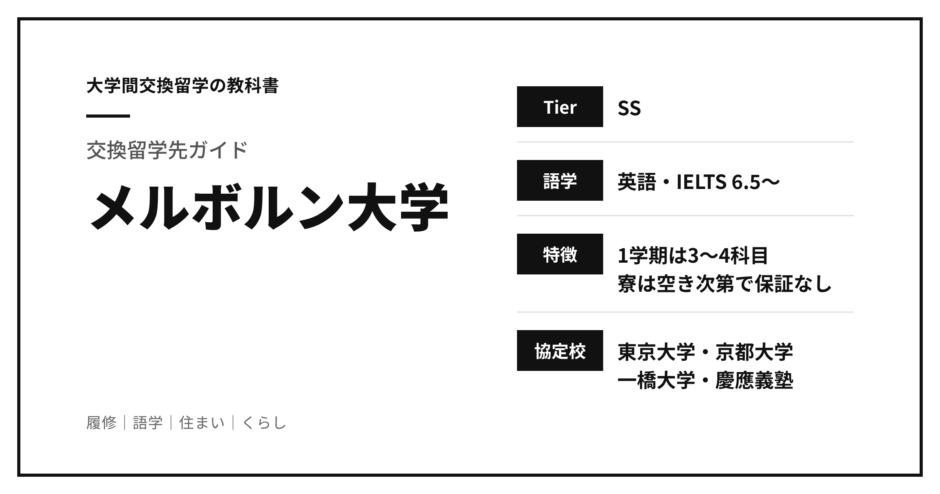
Tier(全9段の上から3番目。SSは14校)
英語の目安(技能別の最低点あり)
バーは満点(IELTS 9.0、TOEFL iBT 120)に対する位置
全学協定のある日本の大学(4校)
東京大学、京都大学、一橋大学、慶應義塾大学
メルボルン大学が候補に入ると、南半球の学期が日本の予定と合うのか、大学の寮に入れるのかが気になりますよね。
私は、専門の授業に加えてほかの分野の授業も英語で幅広く取りたい人にとって、メルボルン大学はオーストラリアで最初に検討していい交換留学先だと思っています。
ただ、いちばんの壁は家賃を中心にした費用と、寮が保証ではないことです。
- 2027年のSemester 1の締切は2026年12月1日、Semester 2は2027年5月1日です。
- 新しく来る交換留学生は大学の住まいのオファーの対象ですが、空きがあればの条件付きです。
1. 大学の特徴
メルボルン大学は1853年に創立した、オーストラリアを代表する研究大学です。
メインのParkvilleキャンパスは市の中心部に近く、ビクトリア州に7つのキャンパスがあります。
学生は5万3千人以上で、そのうち45%が留学生、出身は150以上の国と地域です。
交換協定の相手は40以上の国の200以上の大学です。
2026年9月に出たTHE世界大学ランキング2027では世界34位で国内1位、QS世界大学ランキング2027では世界22位で、国内ではUNSWに次ぐ2位です。
医学・歯学・健康科学部は関係するノーベル賞の受賞者として、フローリーをはじめ7人を挙げています。
芸術と音楽の学部は中心部の南のSouthbankにあり、Victorian College of the ArtsとMelbourne Conservatorium of Musicが入っています。
Parkvilleの隣には、病院や研究機関が集まるMelbourne Biomedical Precinctが広がっています。
学部の教育は「Melbourne curriculum」と呼ばれ、専攻を深めながら専攻の外の授業(breadth)も取る仕組みです。
全学協定で来る交換留学生は学部をまたいで授業を選べるので、この考え方をそのまま体験できます。
交換留学先として使える環境を、学術、履修、英語、住居の4項目で星にしました。
大学の知名度ではなく交換留学生が実際に選べる授業と生活の条件で付けています。
星は、科目の登録や住居を約束するものではありません。
個人的には、星3つの「住居の確保しやすさ」がこの大学を選ぶかどうかの分かれ目だと思っています。
2. 授業と履修
メルボルン大学の交換留学生は1学期に37.5〜50ポイント、つまり3〜4科目を取ります。
学生ビザに必要な最低は37.5ポイントなので、3科目を下回ることはできません。
前提科目のない学部の授業が400以上あり、語学の授業を除けばすべて英語で教えられます。
全学協定で来る学生なら、学部をまたいで授業を選べます。
学部どうしの協定で来る学生は、協定外の学部の授業を2つまでしか取れません。
学部生が取れる大学院の授業は、1学期に1つまでです。
交換留学生に開いていない授業もあります。
歯学の授業、医学の専門課程(Doctor of Medicine)、獣医の専門課程は取れません。
法学部(Melbourne Law School)の授業は大学院レベルで、学士を終えた人か、学部の法学を3年以上終えた人だけが申し込めます。
ビジネスや経済にも、交換留学生が取れない授業がいくつか決まっています。
法や医療を目当てにするなら、学部生として取れる授業があるかを出願前に確かめておくと安心です。
授業は大学の授業カタログ(Handbook)で探し、各授業の「Further information」の欄で交換留学生が取れるかを確かめます。
定員のある授業は先着順で、単位の互換は登録の前に所属大学の承認を取っておきます。
着いてから最初の2週間の動き方は履修登録で失敗しないための記事にまとめています。
成績は80点以上がH1で、50点未満は不合格のNです。
課題をすべて終えるまでメルボルンにいる必要があり、追試もメルボルンで受けます。
受けられそうな授業の例
メルボルン大学で交換留学生が取れそうな授業を、分野ごとに授業名のまま並べます。
ビジネス・経営
・Principles of Management
・Principles of Marketing
・Managing People at Work
・Organisational Behaviour
・Managing for Competitive Advantage
・Brand Management
・Consumer Behaviour
・Advertising and Promotions
・Machine Learning & AI For Business
会計・ファイナンス
・Cost Management
・Accounting for Management Decisions
・Investments
・Derivative Securities
・International Finance
・Finance for Built Environment
経済
・Introductory Microeconomics
・Introductory Macroeconomics
・Quantitative Methods 1
・Econometrics 1
・Globalisation and the World Economy
・Economics and Cities
・Agricultural Economics
・Economics of the Law
法
・Principles of Business Law
・Law in Society
・Sport and the Law
・Public Trials
・Global Human Rights Law
・Law, Culture, Justice
・AI, Ethics and the Law
・Indigenous Treaties and Titles
政治・国際関係
・Australian Politics
・Australian Foreign Policy
・Australian Indigenous Politics
・Australian Indigenous Public Policy
・International Politics
・Introduction to Political Ideas
・Authoritarian Politics
・Democracy and its Dilemmas
・The Politics of Sex
・Race, Ethnicity, and Nationalism
・International Gender Politics
・Politics and the Media
・Israelis & Palestinians: Conflict, Peace
・Terrorism: Shifting Paradigms
歴史
・Controversies in Australian History
・Indigenous History
・Urban Indigenous History
・Histories of Migrant Australia
・Indigenous Cultural Heritage
・Aboriginal Women: Activism & Leadership
・A History of Sexualities
・A History of Violence
・The French Revolution
・Plato to Einstein: A History of Science
・The Dynamics of Scientific Change
・History of Landscape Design
・The History of Cool: Fashion & Attitude
文学・言語学
・Contemporary Poetry and Fiction
・Creative Nonfiction & Multimodal Writing
・Writing Australia
・The Australian Imaginary
・The Anatomy of Melancholy
・Language in Aboriginal Australia
・Intercultural Communication
・Clear Speech and Communication
社会学・人類学
・Melbourne: Urban Anthropology in Action
・Indigenous Australia
・Indigenous Cultures and Knowledges
・Race and Racism in Australia
・Gender, Sexuality, Power: Key Theories
・Popular Culture: From K-pop to Selfies
・Neurodiversity: Blueprints for Belonging
・Crime, Criminology, and Critique
・Crime and Culture
・Gender and Crime
・Race, Ethnicity, Crime and Justice
心理
・Biological Psychology
・Cognitive Psychology
・Developmental Psychology
・Personality and Social Psychology
・Development of the Thinking Child
・Lifespan Social & Emotional Development
・The Integrated Brain
・The Psychopathology of Everyday Life
・Performance Psychology
・Music Psychology
・Perception, Illusions and Art
教育
・Wellbeing, Motivation and Performance
・Learning via Sport and Outdoor Education
・School Experience as Breadth
・Learning and the Digital Generations
・Understanding Knowing and Learning
・Knowledge, Learning and Culture
・Youth and Popular Culture
・Introduction to Indigenous Education
・Sport, Education and the Media
・Playing in a Band: Music & Young People
・Sports Coaching: Theory and Practice
・Sports Science & Coaching Applications
メディア・コミュニケーション
・Advertising, Media and Society
・Internet Communication
・Marketing Communications
・Text and Audio Journalism
・Digital and Mobile Journalism
・Understanding Australian Media
・Australian Film and Television
・Video Games: Remaking Reality
・Exploring Digital Realities
・Technology & Contemporary Life
・Science & Engineering in Popular Culture
数学・統計
・Introduction to Mathematics
・Calculus 1
・Calculus 2
・Linear Algebra
・Accelerated Mathematics 1
・Data Analysis 1
・Probability 1
・Probability 1: Advanced
・Statistics
・Analysis of Biological Data
・Real Analysis
・Vector Calculus
・Group Theory and Linear Algebra
・Introduction to Discrete Mathematics
・Introduction to Operations Research
・Decision Making
・Graph Theory
・Number Theory and Cryptography
・Combinatorics
・Engineering Mathematics
情報・コンピュータ
・Foundations of Computing
・Foundations of Algorithms
・Design of Algorithms
・Algorithms and Data Structures
・Object Oriented Software Development
・Elements of Data Processing
・Database Systems
・Software Modelling and Design
・Computer Systems
・Models of Computation
・Declarative Programming
・Artificial Intelligence
・Media Computation
・Graphics and Interaction
・Advanced Interface Prototyping
・Game Design
物理
・Foundations of Physics
・Physics 1
・Physics 1: Advanced
・Physics 2: Physical Science and Technology
・Physics 2: Life Sciences and Environment
・Physics 2: Advanced
・From the Solar System to the Cosmos
・Introduction to Life, Earth and Universe
化学
・Fundamentals of Chemistry
・Chemistry 1
・Chemistry 2
・Biochemistry and Molecular Biology
・Drugs: From Discovery to Market
生命科学
・Foundational Biology: Life’s Machinery
・Foundational Biology: Life’s Complexity
・Biology of Australian Flora and Fauna
・Genetics in the Media
・Australian Wildlife Biology
・Biotechnology
・Blue Planet – Intro to Marine Biology
・Green Planet: Plants and the Environment
・Marine Biodiversity and Biogeography
・Human Physiology
・Principles of Neuroscience
・Medical Microbiology: Virology
・Medical Microbiology: Parasitology
・Frontiers in Veterinary Science
地球・環境
・The Global Environment
・Wonders of Weather
・Understanding Planet Earth
・Geology for Engineers
・Earth Processes for Engineering
・Past Climates: Icehouse to Greenhouse
・Introduction to Climate Change
・Famine: The Geography of Scarcity
・Natural Environments
・Mapping Environments
・Fire in the Australian Landscape
・Applied Ecology
・Field Ecology
・Tropical Field Ecology
・Vegetation Management and Conservation
・Urban Forest Ecosystems
・Sustainable Development
・Environment and Society
・Human Behaviour and Environment
工学(機械・航空)
・Engineering Technology and Society
・Engineering Modelling and Design
・Engineering Mechanics
・Engineering Materials and Mechanics
・Numerical Methods in Engineering
・Fluid Mechanics
・Thermodynamics and Fluid Mechanics
・Mechanics and Materials
・Systems Modelling and Analysis
工学(土木・建設)
・Sustainable Infrastructure Engineering
・Engineering Risk Analysis
・Geotechnical Modelling and Design
・Structural Theory and Design
・Principles of Building
・Understanding the Built Environment
・Construction of Residential Buildings
・Construction of Concrete Buildings
・Environmental Building Systems
・Steel and Concrete Structural Systems
・Measurement of Building Designs
・Construction Management
・Construction Contract Administration
建築・都市計画
・Foundations of Design: Representation
・Design History & Theory in the Making
・Design Studio Alpha
・Digital Design
・Architectural Technologies 1: Place
・Natural History
・Designing Living Systems
・Site Tectonics
・Landscape Studio: Urban Open Space
・Cities Past and Future
・Introduction to Urban Planning
・Cities: From Local to Global
・Urban Design for People and Places
・Applying Digital Infrastructure
・Research Methods for Planners
・The Making of Melbourne
・Introduction to Property
・Design and Property Principles
・Valuation of Land and Buildings
・Sustainable Management of Design Assets
医療・健康
・Real World Epidemiology
・Ethics and Equity in Health and Medicine
・Communicating for Health, not Harm
・Mechanisms of Human Disease
・Exploring Human Disease
・Genetics, Health, and Society
・Monitoring Food and Nutrition Intake
・Our Planet, Our Health
・Drugs That Shape Society
・Designer Humans – Prospects & Perils
農学・食品
・Discovering Agriculture in Australia
・Agronomy
・Soil Management
・Ecology and Grazing Management
・Intro to Food Science & Human Nutrition
・Food Processing and Preservation
・Food for a Healthy Planet
・Beer Styles and Sensory Analysis
・Australia in the Wine World
・Coffee: Science, Trade & Culture
芸術・音楽
・Making Music for Film and Animation 1
・Pop Song Writing 1
・The Business of Music
・Music, Mind & Wellbeing
・World Music Choir
・Samba Band
・African Music and Dance Ensemble (Breadth)
・Chinese Music Ensemble 1 (Breadth)
・Chinese Music Ensemble 2 (Breadth)
・Indonesian Gamelan Ensemble (Breadth)
・Shakuhachi Ensemble (Breadth)
・Free Play New Music Improvisation Ensemble
・Street Art
・Australian Art
・Contemporary Aboriginal Art
・Art and Indigenous Voice
・Indigenous Art and Changing the Nation
・Stand Up and Be Funny
ここに並べたのは、大学の交換留学生向けの案内(What Can I Study?)と、各学部の公式ページに載っていた授業名です。
歯学、医学や獣医の専門課程、法学部の大学院の授業、交換留学生が取れないと決められたビジネスや工学の授業は載せていません。
学部の案内から取った授業もあるので、交換留学生が取れるかは、出願の前に各授業のFurther informationの欄で確かめてください。
案内に載っていても毎学期開かれるとは限らず、前提科目がある授業も多くあります。
3. 語学要件
交換留学生の英語は、学部生向けの英語要件で審査されます。
- IELTS(Academic)は総合6.5以上で、どの技能も6.0以上
- TOEFL iBTは総合79以上で、Writing 21、Speaking 18、Reading 13、Listening 13以上
- PTE Academicは総合58以上で、どの技能も50以上
1回の受験で満たす必要があり、オンラインや自宅での受験は認められません。
TOEICとDuolingoは、大学の英語要件のページに載っていません。
語学要件の相場はIELTSのスコア別の記事とTOEICだけで応募できるかの記事で比べられます。
成績の条件として、日本の学生は平均70%かC以上が求められます。
一橋大学の2027年夏出発の別表では、メルボルン大学の要件をTOEFL iBT 81かIELTS 6.5と書いていて、大学のページの79と違います。
学内の条件も加わるので、所属大学の募集要項で必要な点数を確かめてください。
個人的には、IELTSで出す人は、どの技能も6.0を下回らないかを先に確かめておくのがおすすめです。
合計点が6.5に届いていても、1つの技能だけが足りないと出願できないからです。
4. 出願と学期の日程
締切は次のとおりで、大学のページでは本人の出願締切、2027年向けの資料では推薦の締切として書かれています。
- Semester 1(2月〜6月)は、前の年の12月1日まで
- Semester 2(7月〜12月)は、5月1日まで
所属大学の学内選考はこの締切より前に終わっている必要があります。
2027年のSemester 1は、出席が必須のWelcome Dayが2月19日、授業が3月1日から5月30日まで、試験が6月7日から25日までです。
2027年のSemester 2は、Welcome Dayが7月16日、授業が7月26日から10月24日まで、試験が11月1日から19日までです。
Welcome Dayに間に合わないときは、遅れて着く承認を前もって取る必要があります。
帰りの航空券は、試験の期間のあとで取るよう大学は案内しています。
受入許可が届くまでに日本側でやることは、学内選考に通った後の手続きの記事で時系列にまとめています。
5. 住まいと費用
新しく来る交換留学生は、大学の住まい(University Accommodation)のオファーの対象です。
ただし空きがあればという条件付きで、希望の寮も保証されないので、入居の保証ではありません。
申込に締切はなく満室になれば終わるので、出願を出したらすぐに申し込むのが安全です。
大学の住まいの家賃は2025年の料金で、自炊の寮が週429〜753豪ドル、食事付きの寮が週676〜851豪ドルです(光熱費とネットを含む)。
契約の期間は決まっていて、Semester 1は2月1日から7月10日、Semester 2は7月11日から翌年の1月31日までです。
Semester 2で行く人は、11月に試験が終わっても1月末まで家賃がかかります。
学外の家賃は、メルボルン都市圏の1寝室で中央値が週425豪ドルです。
寮と民間の部屋を探す順番は、住居の探し方の記事で解説しています。
住まいのほかに見ておきたい費用は次の4つです。
- 授業料は所属大学に払い、学生サービスの料金も留学生は払いません。
- 学生ビザ(subclass 500)が必要で、申請料は2026年7月1日から2,500豪ドルです。
- オーストラリアの留学生向け保険(OSHC)が必須で、日本の保険は認められません。金額は保険会社のサイトで確かめるよう大学は案内しています。
- 大学の案内では、食費と外食に週140〜280豪ドル、交通に週30〜60豪ドルが目安です。
空港には大学が手配する無料の出迎えがあり、到着の4日以上前に予約が必要です。
保険の選び方は海外保険の記事、寮の費用を豪ドルで払う方法は大学・寮への送金の記事にあります。
自分の期間と住まいでいくらになるかは、費用シミュレーターで計算してみてください。

6. 国と街のくらし
国別の勉強・文化・くらしの記事から、オーストラリアの項目のうちメルボルンの生活に関係するものを抜き出しました。
交換留学生の目線で、独断と偏見でまとめた箇条書きです。
- 1学期3〜4科目で、1科目の密度が濃い
- 講義とチュートリアルがセットで、出席を取られるのはチュートリアル
- 講義は録画されていて後から見返せる
- 毎週の小テスト、グループ課題、エッセイ、中間、期末の積み上げ型
- 期末で最低点を取らないと、他が良くても落ちる科目がある
- 最初の数か月はオージー英語の速さとアクセントが聞き取れない
- 安い寮から埋まるので早いもの勝ち
- 外食とカフェは日本の2〜3倍
- 現地の保険(OSHC)が必須で、日本の保険と二重払いになる
- 学生ビザでバイトでき、時給も高い
- ただし課題が重い学部だとバイトの余裕はない
- 季節は日本と逆で、都市によって気候がまるで違う
- 時差が小さく、日本の就活と連絡を取りやすい
- シドニー、メルボルン、ゴールドコーストは日本人が多い
- 現地のサークルに入ったほうが英語を使う環境を作れる
- メルボルンは中心部のトラムが無料
大学の資料によると、メルボルンはビクトリア州の州都でオーストラリア第2の都市で、人口は約530万人です。
住民の38%が海外の生まれで、140の文化がある多文化の街だと大学は紹介しています。
緊急のときの電話番号(救急、消防、警察)は000なので、着いたらすぐに携帯に登録しておくと安心です。
学生ビザの申請の流れはビザの記事で国ごとの違いとあわせて説明しています。
7. ゆかりのある人物
日本人でメルボルン大学を卒業したことを公表している著名人は、今回調べた範囲では大学の資料で確かめられませんでした。
そのかわり、メルボルン大学には100年以上続く日本語教育の歴史があります。
大学の資料によると、最初の日本語の学生は1919年に入学しました。
1918年に日本語を教える最初の教員の一人として提案された稲垣(Senkichi Inagaki)は、1920年代の初めに日本語の学科を率いました。
日本の同窓会は1998年に12人で始まり、いまは東京と大阪を中心に約620人が参加しています。
海外で知られた卒業生には、オーストラリアの首相を務めたジュリア・ギラード、哲学者のピーター・シンガー、作家のジャーメイン・グリアがいます。
子宮頸がんのワクチンの開発を率いたイアン・フレイザーも卒業生です。
個人的には、日本の同窓会があることを知っておくと、帰国してからもメルボルンでのつながりを続けやすいと思います。
8. 日本からの応募ルート
冒頭の4大学は日本側の公式のページで、メルボルン大学との全学の交換を確かめられた大学です。
東京大学はUSTEP、京都大学は大学間の協定(派遣枠5)、一橋大学は全学交流協定(枠3.0)、慶應義塾大学は全塾派遣の春募集として載っています。
早稲田大学は2021年の留学フェアの案内で交換留学のプログラムとして紹介されていましたが、今年度の一覧では確かめられませんでした。
大阪大学は以前の版の記事で協定校に入れていましたが、今回は大学の公式ページで協定を確かめられなかったので外しています。
東京大学の工学系のように、部局どうしの協定で行けるルートもあり、その場合は全学の交換と条件が違います。
協定があっても、毎年募集があるとは限りません。
所属大学の募集要項で、メルボルン大学の枠と、全学か学部どうしの協定か、Semester 1とSemester 2のどちらから行けるかを確かめてください。
協定のない大学からは、授業料を払って行くStudy Abroadという別の道があり、2027年は1学期4科目で13,000豪ドルが目安です。
留学先検索で、所属大学からメルボルン大学への交換留学ルートを見る
9. 向いている人
メルボルン大学が合いやすいのは、次のような人です。
- 専門の授業に加えて、ほかの分野の授業も英語で幅広く取りたい人
- IELTSでどの技能も6.0以上を取れる人
- 日本との時差が小さい国で、就活などの連絡も続けたい人
反対に、次に当てはまる人は出願の前に確かめておくと安心です。
- 法や医療の専門科目を中心に取りたい学部生
- 大学の寮に入れることを前提に計画している人
- Semester 2で行き、1月末まで続く寮の契約と帰国の予定が合わない人
同じオーストラリアで比べるなら、シドニー大学も候補になります。
まとめ
- メルボルン大学はオーストラリアを代表する研究大学で、交換留学生は1学期に3〜4科目(37.5〜50ポイント)を英語で取ります。
- 英語はIELTS 6.5(各6.0以上)かTOEFL iBT 79(技能別の最低点あり)が基準で、2027年のSemester 1の締切は2026年12月1日です。
- 寮は空きがあればのオファーで保証ではなく、自炊の寮で週429〜753豪ドルが目安です。
今日やることは、所属大学の募集要項で、メルボルン大学の枠と学内選考の締切を確かめることです。
参考資料:Melbourne Exchange and Study Abroad Fact Sheet 2027(東京大学掲載、PDF) / Melbourne Facts and figures / Melbourne Newsroom:QS World University Rankings 2027 / Times Higher Education:University of Melbourne(World University Rankings 2027) / Melbourne Exchange and study abroad / Melbourne Selecting subjects / Melbourne Faculty-specific requirements and restrictions / Melbourne What Can I Study? 2025(東京大学掲載、PDF) / Melbourne Entry requirements / Melbourne Undergraduate English language requirements / Melbourne Important dates / Melbourne Accommodation eligibility / Melbourne Accommodation FAQs / Melbourne Cost of living / Melbourne Fees and costs(Exchange and Study Abroad) / Melbourne OSHC / Study Australia Student visa application charge increase / Melbourne Medicine, Dentistry and Health Sciences: Our contributions / Melbourne Library Collections(日本語教育の始まり) / University of Melbourne Alumni Japan / Melbourne Notable alumni / 東京大学 USTEP・メルボルン大学 / 京都大学 大学間学生交流協定校一覧(オセアニア、PDF) / 一橋大学 海外派遣留学 別表1(2027年夏出発、PDF) / 慶應義塾大学 2027年度派遣交換留学生募集要項(PDF) / 早稲田大学 2021年春 留学フェア
制度、募集、語学要件、費用は年度や所属大学によって変わります。応募の前に、所属大学とメルボルン大学の最新の案内を確かめてください。最終確認:2026年10月31日
「お気に入り」追加済みの記事