【大学間交換留学の教科書編集部】
交換留学を考える大学生のための、大学や留学エージェントから独立した情報サイトです。
全国の旧帝大で交換留学や海外大学院留学を経験したメンバーが、自分たちの経験と公式情報をもとに運営しています。
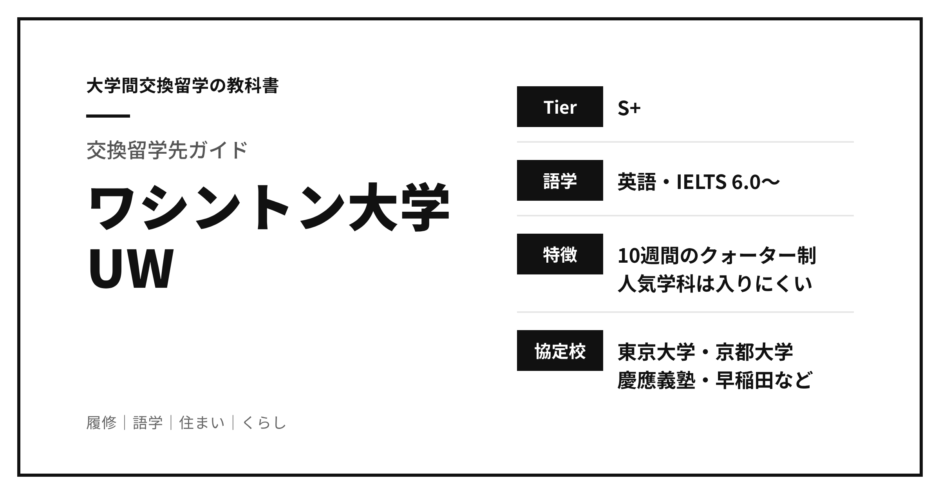
Tier(全9段の上から4番目。S+は30校)
英語の目安(最低点。推奨はさらに上)
バーは満点(IELTS 9.0、TOEFL iBT 120)に対する位置
全学協定のある日本の大学(11校)
東京大学、京都大学、大阪大学、北海道大学、九州大学、神戸大学、東京科学大学、慶應義塾大学、早稲田大学、青山学院大学、立教大学
ワシントン大学(UW)が候補に入ると、英語のスコアは足りるのか、学期の区切りが日本の大学と合うのかが気になりますよね。
私は、アメリカの大きな総合大学で、専門の外の授業まで英語で取りたい人にとって、UWは最初に検討していい交換留学先だと思っています。
ただ、いちばんの壁は人気の学科の授業に入りにくいことです。
- UWへの出願の締切は、秋学期が3月15日、冬学期が8月15日、春学期が11月15日です。
- 学内の寮は、出願で希望した学部生が優先リストに載る仕組みで、保証の記載はありません。
1. 大学の特徴
UWは1861年に創立した、ワシントン州立の総合大学です。
本拠地のシアトル校には、教室や図書館とともに研究施設、大学病院、スタジアムが集まっています。
名前が似ていますが、ミズーリ州のセントルイス・ワシントン大学とは別の大学です。
情報、工学、医療・公衆衛生、海洋・環境、人文・社会科学まで分野が広く、大学のまわりにはIT、航空宇宙、医療の産業が集まっています。
キャンパスの近くの駅からライトレール(電車)で市の中心部や空港にも出られます。
交換留学先として使える環境を、学術、履修、英語、住居の4項目で星にしました。
大学の知名度ではなく交換留学生が実際に選べる授業と生活の条件で付けています。
星は、科目の登録や住居を約束するものではありません。
個人的には、星3つの「履修自由度」がこの大学を選ぶかどうかの分かれ目だと思っています。
2. 授業と履修
UWは秋・冬・春の3学期に分かれたクォーター制で、1学期は10週間の授業と1週間の期末試験です。
全学協定で行く学部生は所属大学での専攻や学年にかかわらず、文理学部(College of Arts & Sciences)に入ります。
学部どうしの協定で行く人は、その学科に入ります。
ビザの条件で、学部生は1学期に12 credits以上を取る必要があり、授業料の免除は18 creditsまでです。
UWの授業は1つ1〜5 creditsで、交換留学生はふつう3〜4科目、12〜15 creditsほどを取ります。
交換留学生に開いていない分野もあります。
ビジネス(Foster)、情報学部(Information School)、医学、看護、薬学などの専門職向けのプログラムと、アート・デザインのスタジオの授業は取れません。
さらに、建築、ビジネス、コミュニケーション、コンピュータサイエンス(CSE)、デザイン、経済、工学、法、数学、心理などは競争が激しく、UWの学位を取る学生が優先されます。
CSEの授業は学期の前に申請しますが、席は保証されません。
人気の学科の授業を目当てにするなら、その学科以外で取れる代わりの授業も一緒に用意しておくと安心です。
授業の登録はUWの学生IDができたあと、自分で行います。
上級の授業は学科の許可がいるものが多いので、登録が始まる前に学科の担当者へ連絡するのが近道です。
着いてから最初の2週間の動き方は履修登録で失敗しないための記事にまとめています。
10週間の学期では、読む課題と宿題と小テストが毎週続き、中間試験が何回もある授業もあります。
日本の半期と同じ感覚で授業数を増やすと追いつかなくなるので、1学期目は3科目から始めるのも手です。
受けられそうな授業の例
UWで交換留学生が取れそうな授業を、分野ごとに授業名のまま並べます。
経済
・Introduction to Microeconomics
・Introduction to Macroeconomics
・Economics of Sports
・Introduction to Environmental Economics
・Intermediate Microeconomics
・Intermediate Macroeconomics
・Introduction to Health Economics
・Introduction to Econometrics
・Behavioral Economics
・Money, Credit, and the Economy
・Investment, Capital, and Finance
・Computational Finance and Financial Econometrics
・Central Banking
・Public Finance: Tax Policy
・International Trade
・International Finance
・Game Theory with Applications to Economics
・Causal Inference
・Issues in Economic Development
・Economy of Japan
・Economic Analysis of the Law
法
・Introduction to Law, Societies, and Justice
・Race, Law, and Justice
・Foundations of International Law
・Politics of International Law
・Introduction to United States Constitutional Law
・Comparative Law and Legal Cultures
・Comparative Law and Courts
・Immigration, Citizenship, and Rights
・Human Rights Law in Culture and Practice
・Privacy
・Punishment: Theory and Practice
・Law, Justice, and the Environment
・Global Environmental Law and Politics
・Miscarriages of Justice
・Science, Technology, and Justice
政治・国際関係
・Introduction to Politics
・Introduction to Political Theory
・Introduction to American Politics
・Introduction to International Relations
・Introduction to Comparative Politics
・American Foreign Policy
・International Organizations
・Political Violence
・Strategy and War
・Global Environmental Politics
・European Union as Global Actor
・International Political Economy
・United States-China Relations
・International Relations of Japan
・National Security of Japan
・Politics of Divided Korea
・The Making of the Modern World
・Contemporary International Problems
・Rise of Asia
・Understanding the Global Economy
歴史
・Survey of the History of the United States
・Asian American History
・American Slavery
・History of the Digital Age
・Civil Rights and Black Power in the United States
・The United States and Vietnam
・Diplomatic History of the United States, 1901-Present
・History of Washington and the Pacific Northwest
・The Sixties in America: Kennedy to the Counterculture
・Japanese Civilization
・History of Chinese Civilization
・History of Korean Civilization
・History of Southeast Asia
・Modern China: Three Revolutions
・The Viet Nam Wars
・Japan Since the Early 20th Century
・History of the Japanese Empire
・History of Modern India to 1900
哲学・宗教
・Introduction to Philosophy
・Contemporary Moral Problems
・Introduction to Logic
・Introduction to Ethics
・Introduction to Medical Ethics
・Environmental Ethics
・Introduction to Philosophy of Religion
・Ancient Philosophy
・Modern Philosophy
・Classical Chinese Philosophy
・Philosophy of Human Rights
・Introduction to the Philosophy of Mind
・Philosophy of Law
・Philosophy of Kant
・The Political Philosophy of John Rawls: Justice and Liberalism
・Philosophy of Science
・Philosophy of Film
・Philosophy and Video Games: I Play Therefore I Am
・Comparative Religion
文学・言語学
・Shakespeare
・American Literature
・Asian American Literature
・Introduction to Environmental Humanities
・The Bible as Literature
・Postcolonial Literature and Culture
・Rise of the English Novel
・Science Fiction and Fantasy
・World Englishes
・History of the English Language
・Children’s Literature
・Introduction to Linguistics
・Language and Thought
・Introduction to Language and Society
・Swearing and Taboo Language
・Languages of the World
・Japanese Syntax and Semantics
・Sociolinguistics I
・Introduction to Computational Linguistics
・Second-Language Learning
社会学・人類学
・Survey of Sociology
・Introduction to Urban Sociology
・Sociology of Sport
・Social Problems
・Introduction to Sociological Theory
・Population and Society
・The Family
・Sociology of Religion
・Race Relations
・Criminology
・Environmental Sociology
・Immigration and Ethnicity
・Contemporary Society in the People’s Republic of China
・Introduction to Anthropology
・Introduction to Medical Anthropology and Global Health
・Anthropology of Food
・Anthropology of Modern Japan
・Economic Anthropology
・Visual Anthropology
・Cultures of Global Capital
心理
・Introduction to Psychology
・Biopsychology
・Human Development
・Happiness
・Introduction to Social Psychology
・Personality
・Developmental Psychology
・Social Psychology
・Cognitive Psychology
・Psychology of Emotion
・Psychology of Language
・Organizational and Industrial Psychology
・Health Psychology
・Cognitive Neuroscience
・Psychology and Music
・Cultural Psychology
・Stress and Coping
・Clinical Psychology
教育
・Purposes of Higher Education
・History of American Education: Power and Justice
・Current Issues in Education
・Political Philosophy of Education
・Introduction to Education
・Seeking Educational Equity and Diversity
・Equity Issues in K-12 Education
・Issues and Trends of Educational Theory, Research, and Practice
・Educational Leadership for Social Change
・Learning Within and Across Settings
・Digital Media Literacy
・The Role of Sport in Social Justice and Change
・Sociology of Education
・Anthropology of Education
メディア・コミュニケーション
・Introduction to Communication
・Introduction to Public Speaking
・Introduction to Rhetoric
・Interpersonal Communication
・Social Effects of Technology and Social Media
・Global Communication
・The Business of Media in the Digital Age
・History of Mass Communication
・Effects of Mass Communication
・Foundations of Journalism and Public Interest Communication
・Organizational Communication
・Communication Ethics
・Nonverbal Communication
・Mass Media and Public Opinion
・Mass Media Law
・Public Relations and Society
・Crisis Communications
・Data Reporting
・Intercultural Communication
・Media and Society
数学・統計
・Calculus with Analytic Geometry I
・Discrete Mathematics I
・Introduction to Differential Equations
・Matrix Algebra with Applications
・Introduction to Mathematical Reasoning
・Introductory Real Analysis I
・Probability I
・Introduction to Modern Algebra
・Linear Optimization
・History of Mathematics
・Complex Analysis
・Topology
・Stochastic Calculus for Option Pricing
・Statistical Reasoning
・Introduction to Data Science
・Statistical Computing
・Introduction to the Ethics of Algorithmic Decision Making
・Applied Regression and Analysis of Variance
・Introduction to Statistical Machine Learning
・Visualizing Data
情報・コンピュータ
・Computer Science Principles
・Introduction to Computer Programming I
・Web Programming
・Data Programming
・Artificial Intelligence Principles, Applications, and Impacts
・Foundations of Computing I
・Software Design and Implementation
・Data Structures and Parallelism
・Systems Programming
・Introduction to Data Management
・Data Structures and Algorithms
・Software Engineering
・Introduction to Artificial Intelligence
・Introduction to Machine Learning
・Introduction to Algorithms
・Cryptography
・Introduction to HCI: User Interface Design, Prototyping, and Evaluation
・Natural Language Processing
・Computer Vision
・Computer Security
物理
・Quantum Mechanics, Relativity, and the Foundations of Our Modern Technological World
・Liberal Arts Physics
・Mechanics
・Electromagnetism
・Waves, Light, and Heat
・The Physics of Music
・Light and Color
・Energy Future: The Technical and Social Barriers to Large-Scale Sustainable Energy
・Thermal Physics
・Introduction to Quantum Mechanics
・Introduction to Computational Physics
・Electromagnetism I
・Quantum Mechanics I
・Statistical Physics
・Quantum Computing
・Contemporary Nuclear and Particle Physics
・Contemporary Condensed Matter Physics
・Biophysics
化学
・General Chemistry I
・General Chemistry II
・Organic Chemistry
・Organic Chemistry Laboratory
・Inorganic Chemistry
・Quantitative Analysis
・Nuclear Chemistry
・Instrumental Analysis
・Polymer Chemistry
・Chemical Biology
・Quantum Mechanics of Atoms and Molecules
・Chemical Thermodynamics
・Air Pollution Chemistry
・Computational Chemistry
・Big Data for Materials Science
・Energy Materials, Devices, and Systems
生命科学
・Introductory Biology
・Evolution and Human Behavior
・Introduction to Neuroscience
・Marine Biology
・Introduction to Conservation Biology
・Genetics and Molecular Ecology
・Foundations in Physiology
・Foundations in Molecular Cell Biology
・Foundations in Ecology
・Cellular and Molecular Biology of Human Disease
・Stem Cell Biology
・Developmental Biology
・Biological Clocks and Rhythms
・Marine Ecology
・Ornithology
・Neurobiology
・Molecular Mechanisms of Cancer Seminar
・Conservation Biology
・Biology of Fermentation
地球・環境
・Dinosaurs
・Natural Hazards and Disasters
・Living with Volcanoes
・Earth’s Climate System
・Glaciers and Global Change
・Geology of the Northwest
・Geology of the National Parks
・Introduction to Seismology
・Principles of Glaciology
・Introduction to Remote Sensing for the Earth Sciences
・Environment and Society: Understanding Issues, Finding Solutions
・Sustainability and Environmental Justice
・Climate Governance: How Individuals, Communities, NGOs, Firms, and Governments Can Solve the Climate Crisis
・Food and the Environment
・Natural History of the Puget Sound Region
・Introduction to Restoration Ecology
・Climate Justice
・Introduction to Environmental Law and Process
工学(機械・航空)
・Kinematics and Dynamics
・Engineering Thermodynamics
・Introduction to Heat Transfer
・Introduction to Fluid Mechanics
・Energy and Environment
・Introduction to Manufacturing Processes
・Machine Design Analysis
・Additive Manufacturing: Materials, Processing and Applications
・Renewable Energy II
・Mechanical Vibrations
・Automatic Control
・Finite Element Analysis
・Technology-Based Entrepreneurship
・Air and Space Vehicles
・Engineering Statics
・Orbital and Space Flight Mechanics
・Aircraft Design I
・Rocket Propulsion
・Systems Engineering
・Space Law, Business, and Policy
工学(電気・電子)
・Fundamentals of Electrical Engineering
・Circuit Theory
・Digital Circuits and Systems
・Devices and Circuits
・Signals, Systems, and Data I
・Data-Driven Modeling and Machine Learning
・Introduction to Robotics and Control Systems
・Energy Systems
・Applied Electromagnetics
・Modern Wireless Communications
・Network Security and Cryptography
・Digital Signals and Filtering
・Wind Energy
・Power System Analysis
・Neural Engineering
・Antennas: Analysis and Design
・Semiconductor Devices
・Introduction to Photonics
工学(土木・建設)
・Introduction to Civil and Environmental Engineering
・Introduction to Mechanics of Materials
・Construction Engineering
・Transportation Engineering
・Construction Materials
・Geotechnical Engineering
・Introduction to Structural Design
・Structural Analysis
・Environmental Engineering
・Sustainable Construction
・Traffic Engineering Fundamentals
・Machine Learning for Civil Engineers
・Transit Systems Planning
・Engineering, Environment, and Justice
・Foundation Design
・Design of Reinforced Concrete Structures
・Coastal Engineering I
・Drinking Water Treatment
建築・都市計画
・Introduction to Architectural Studies
・Appreciation of Architecture I
・Introduction to Structures I
・Architecture of the Ancient World
・History of Modern Architecture
・Architecture and Theory
・Computers in Architecture
・Life Cycle Assessment and Architecture
・Energy and Environmental Systems for Buildings
・Building Acoustics
・Visions of the Japanese House
・Japanese Architecture
・History of Architecture in Seattle and Environs
・Architecture Since 1945
・Fundamentals of Building Information Modeling
医療・健康
・Introduction to Global Health: Disparities, Determinants, Policies, and Outcomes
・Multidisciplinary Perspectives in Global Health
・Global Environmental Change and Public Health
・Global Health and Justice
・Global Health Economics
・War and Health
・Global Mental Health
・One Health: Human and Animal Health in a Changing Environment
・The Health of Populations
・Outbreak Investigation and Response
・Introduction to Epidemiology
・Exploring the HIV/AIDS Pandemic
・Maternal and Child Health-a Population Health Approach
・Sexually Transmitted Infections: Causes and Consequences
農学・食品
・Introduction to Foods
・Nutrition for Today
・Culinary Nutrition Science
・Food Systems: Harvest to Health
・Nutrition and the Life Course
・Food System Sustainability and Resilience
・Sports Nutrition
・United States Food Systems Policy
・Global Nutrition: Challenges and Opportunities
・Economics of Sustainable Food Systems
・Food and Culinary Science
・Nutritional Anthropology
・The Urban Farm
・Agriculture and Urban Food Systems Seminar
・Agroecology
芸術・音楽
・Survey of Western Art-Modern
・Arts of Japan
・Chinese Art and Visual Culture
・History and Theory of Photography
・French Impressionism and Post Impressionism
・Italian Renaissance Art
・Art Since World War II
・Art Museums: History, Theory, Practice
・Buddhist Arts of Asia
・Introduction to Classical Music
・History of Jazz
・American Musical Theater
・World Music
・Roots and Routes of Rap
・Music in Cinema
・Psychology of Music: Cognition
・The Blues
・Music of Japan
・Fundamentals of Music Technology
ここに並べたのは、UWの授業カタログに載っている学部の授業名です。
カタログは開かれる可能性のある授業の一覧で、毎学期すべてがあるわけではありません。
ビジネス(Foster)、情報学部、アート・デザインのスタジオの授業は交換留学生が取れないので、ここには載せていません。
経済、コンピュータサイエンス、工学、建築、数学、心理、コミュニケーション、法(Law, Societies & Justice)はUWの学位の学生が優先で、席は保証されません。
上級の授業は学科の許可がいるものが多いので、出願の前に学科の案内で確かめてください。
3. 語学要件
UWが交換留学生に求める英語の点数は次のとおりです。
- TOEFL iBT(2026年1月21日より前の試験)は最低76、推奨105
- TOEFL iBT(2026年1月21日からの新方式)は最低4.0、推奨4.5
- IELTSは最低6.0、推奨7.0
- Duolingo English Testは最低110、推奨125
GPAは4.0満点で3.0以上が必要です。
大学院生として行く場合は、最低点ではなく推奨点が求められます。
最低点は出願できるかどうかの線で、授業についていくには推奨点に近いほど楽になります。
TOEFL iBTは2026年1月から点数の出し方が変わったので、どちらの方式で受けたかを確かめてから比べてください。
TOEICは使えないので、TOEICで応募できる大学と比べている人はTOEICだけで応募できるかの記事も参考にしてください。
IELTSの点数ごとに行ける大学の違いはIELTSのスコア別の記事で比べられます。
個人的には、最低点で出願できても、授業のための英語の準備は推奨点を目標にしておくのがおすすめです。
アメリカの授業は読む量と発言の量が多く、6章で紹介するとおり、ディスカッションで苦労する人が多いからです。
4. 出願と学期の日程
UWの出願の日程は次のとおりです。
- 秋学期(9月下旬に始まる)は、推薦が3月1日まで、出願が3月15日まで
- 冬学期(1月に始まる)は、推薦が8月1日まで、出願が8月15日まで
- 春学期(3月末に始まる)は、推薦が11月1日まで、出願が11月15日まで
所属大学の学内選考はこの推薦より前に終わっている必要があります。
出願ではパスポートの写し、成績証明書、英語の証明を出し、受入が決まったあとに残高の証明を出します。
出願したあとの流れは秋学期の場合で次のとおりです。
- 5月下旬から6月初めに受入の結果が届く
- 6月中旬から下旬に、J-1ビザに必要な書類(DS-2019)が出る
- 6月から9月に授業を登録する
- 授業が始まる約1週間前にオリエンテーションがある
冬学期は10月中旬から下旬、春学期は1月中旬から下旬に結果が届きます。
日本の大学の学期とずれるので、所属大学がどのクォーターを留学の期間として認めるかを先に確かめてください。
受入許可が届くまでに日本側でやることは、学内選考に通った後の手続きの記事で時系列にまとめています。
5. 住まいと費用
UWの学内の住まいは、出願で希望した学部生が優先リストに載り、そのリストをもとに大学の住宅課が案内します。
優先リストに載るだけで、部屋が保証されるという記載はありません。
申込みには受入許可とUWのIDが必要で、契約は9か月か12か月です。
学外の部屋やホームステイは、UWと連携する留学生支援団体(FIUTS)が紹介しています。
UWは留学生の生活費を、住まいや食費を含めて1学期7,444ドルと見積もっています。
シアトルは家賃が高い街なので、学外で探すときは家具、光熱費、短い契約ができるかも合わせて見てください。
寮と民間の部屋を探す順番は、住居の探し方の記事で解説しています。
住まいのほかに見ておきたい費用は次の4つです。
- 授業料と技術料は免除で、所属大学に払います。
- 大学の保険(ISHIP)は1学期458ドルで、同じ条件の保険があれば免除を申請できます。
- 交通パス(U-PASS)、授業ごとの追加料金、18 creditsを超えた分は自分で払います。
- ほとんどの交換留学生はJ-1ビザが必要で、受入のあとに書類を申請します。
払う必要のない新入生の手数料(NSEOF)が請求に載ることもあるので、払う前に確かめてください。
保険の選び方は海外保険の記事、寮の費用をドルで払う方法は大学・寮への送金の記事にあります。
自分の期間と住まいでいくらになるかは、費用シミュレーターで計算してみてください。
6. 国と街のくらし
国別の勉強・文化・くらしの記事から、アメリカの項目のうちUWの生活に関係するものを抜き出しました。
交換留学生の目線で、独断と偏見でまとめた箇条書きです。
- 有名校は倍率が高いが、人気校以外は枠が余ることも多い
- 実際に行く人のスコアはTOEFL 90〜110、IELTS 6.5〜7.5あたり
- 課題が死ぬほど多い、毎回数十ページのリーディングと短いエッセイ
- 成績は毎週の宿題、小テスト、中間、レポートの積み上げ
- 大教室でも学生が普通に手を挙げて質問しまくる
- ディスカッションは割り込むタイミングがつかめず、ここが一番しんどい
- オフィスアワーは使った者勝ち、教授もTAも気さく
- 取る科目数は日本より少ないが、1科目が重い
- 交換留学生もフルタイム在籍が条件なので、授業を減らしすぎるとビザ的にアウト
- 最初はネイティブ同士の雑談がほぼ聞き取れない
- 寮に住むとミールプランもセットで強制
- 大学指定の保険は強制加入で、免除の手続きもめんどう
- 円安で物価が高く、ブランチでもチップ込みで15〜20ドル
- 長期休みは寮が閉まることがあるので、行き先を先に確保
- 都市部の公共交通は、夜は避けたいエリアも多い
- お酒は21歳から
- 学外バイトはビザ上ほぼ無理、学内バイトも枠は少ない
- 就活はボストンキャリアフォーラムが定番
- 最初は留学生とつるみがちで、アメリカ人の友達はなかなかできない
- ビザは大使館で面接がある
同じ記事では、アメリカで協定が多い大学の1つにUWを挙げています。
シアトルは秋から春にかけて曇りや小雨の日が多いので、冬学期から行く人は室内で過ごす時間の使い方も考えておくとよいです。
カナダのバンクーバーまでは陸路で行ける距離なので、同じS+のブリティッシュ・コロンビア大学と比べてみるのもおすすめです。
J-1ビザの面接の流れはビザの記事で国ごとの違いとあわせて説明しています。
7. ゆかりのある人物
UWは日系アメリカ人とのゆかりが深い大学です。
ニューヨークのワールドトレードセンターを設計した建築家のミノル・ヤマサキは、シアトル生まれの日系二世で、1934年にUWで建築を学んで卒業しました。
夏のあいだはアラスカの缶詰工場で働いて学費をまかなったそうです。
UWの発表によると、ヤマサキはUWと同窓会がその年の卒業生として表彰した最初の日系アメリカ人でもあります。
ゴードン・ヒラバヤシは第二次世界大戦中にUWの学生だった日系アメリカ人です。
1942年に日系人に出された夜間外出禁止令などに従わず、裁判で最高裁まで争いました。
有罪は1986年に覆り、ヒラバヤシは戦後にUWで学士、修士、博士を取っています。
1942年には、日系アメリカ人の学生400人以上が強制収容によってUWを去らされました。
UWは2008年5月18日、この学生たち449人に名誉学士号を贈っています。
個人的には、キャンパスを歩く前にこの歴史を知っておくと、日本から来た留学生として見えるものが変わると思います。
8. 日本からの応募ルート
冒頭の11大学は、当サイトの留学先検索(文部科学省の調査をもとにしたデータベース)でUWと全学の交換留学協定がある大学です。
UWの全学協定は学部生向けで、大学院生は学科どうしの協定でしか受け入れていません。
学部や学科どうしの協定で行く人は、その学科に入るので、取れる授業の範囲が全学協定と変わります。
協定があっても、毎年募集があるとは限りません。
所属大学の募集要項で、UWの枠と、秋・冬・春のどのクォーターから行けるか、対象の学部を確かめてください。
当サイトの交換留学先大学ティアリストで、同じS+の大学と比べてみるのもおすすめです。
留学先検索で、所属大学からワシントン大学への交換留学ルートを見る
9. 向いている人
UWが合いやすいのは、次のような人です。
- 専門にこだわらず、文理の幅広い授業を英語で取りたい人
- 10週間ごとに区切られた学期で、集中して学びたい人
- IT、航空宇宙、医療など、シアトルの産業と学びをつなげたい人
反対に、次に当てはまる人は出願の前に確かめておくと安心です。
- ビジネスやコンピュータサイエンスの授業を必ず取りたい人
- 英語のスコアが最低点ぎりぎりで、読む量の多い授業に不安がある人
- 日本の大学の学期とクォーターのずれを、単位の認定でうまく合わせられない人
まとめ
- UWはシアトルの総合大学で、全学協定の学部生は文理学部に入り、1学期12〜18 creditsを10週間で取ります。
- 英語はIELTS 6.0かTOEFL iBT 76(新方式4.0)から出せますが、推奨はIELTS 7.0、TOEFL iBT 105です。
- 寮は希望すれば優先リストに載りますが保証の記載はなく、生活費は1学期7,444ドルが目安です。
今日やることは、所属大学の募集要項で、UWの枠と行けるクォーター、学内選考の締切を確かめることです。
参考資料:UW Visiting Exchange Application / UW Visiting Exchange Academics / UW Visiting Exchange Admitted Students / UW Visiting Exchange Registration / UW International Student Services Money Matters / 東京大学 掲載 UW University-wide Exchange Fact Sheet(PDF) / 東京大学 掲載 UW Fact Sheet 2024-2025(PDF) / UW Foster Inbound Exchange Students / UW News(ミノル・ヤマサキ) / PCAD(ミノル・ヤマサキ) / UW Magazine(ゴードン・ヒラバヤシ) / UW OMA&D(ゴードン・ヒラバヤシ) / Wikipedia(Gordon Hirabayashi) / UW Office of Ceremonies(1941・1942年の日系アメリカ人学生) / 文部科学省「大学等間交流協定締結状況等調査」 / UW Course Catalog
制度、募集、語学要件、費用は年度や所属大学によって変わります。応募の前に、所属大学とUWの最新の案内を確かめてください。最終確認:2026年10月31日
「お気に入り」追加済みの記事